Radiocalcium dating
Research background
Calcium (Ca) is a major element widely distributed in the lithosphere, hydrosphere, and biosphere. The radioactive isotope 41Ca is an in-situ produced cosmogenic nuclide with a half-life of (99.4 ± 1.5) kyr [ 1 ]. 41Ca is primarily formed through the capture of low-energy neutrons by 40Ca (40Ca (n,γ) 41Ca), which happens at depths of a few meters below the Earth's surface. The isotopic abundance of 41Ca (41Ca/Ca) is extremely low, generally on the order of 10-18 to 10-15, and has been analyzable using the ATTA method since 2023 [ 2, 3, 4 ].
41Ca is regarded as an ideal dating tracer for the Middle to Late Pleistocene period [ 5 ], covering an age range of approximately 50–500 ka, which is beyond the reach of 14C dating. The applications of 41Ca dating are extensive. Burial dating is suitable for biological specimens: they exchange calcium with the environment during their lifetimes and are buried in water bodies or caves after death. Exposure dating is applicable to rocks exposed on the surface due to geological events (such as earthquakes, volcanic eruptions, water level decline, or glacial retreat). The detection of 41Ca will advance research in paleoclimatology, paleoenvironmental studies, and paleoanthropology.
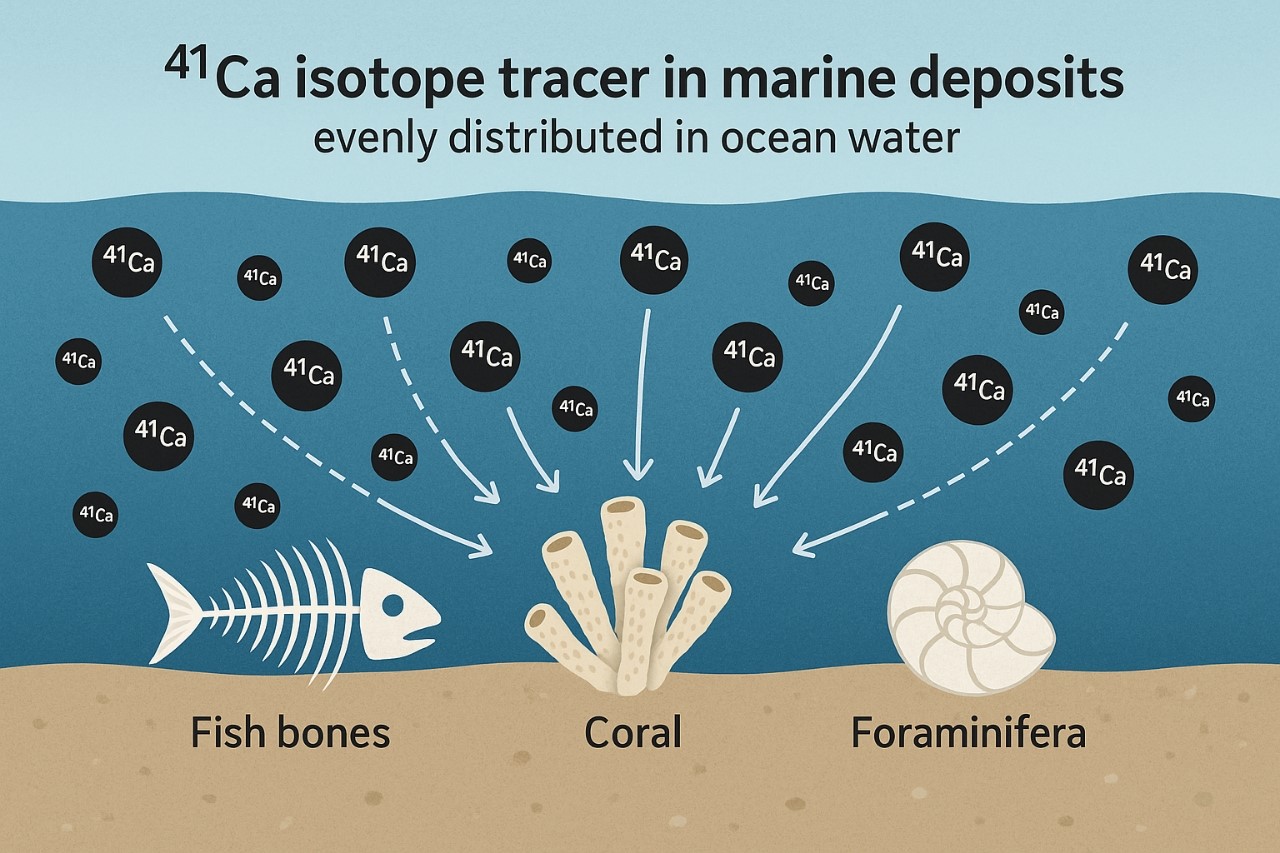
Fig 1. 41Ca in the Ocean.
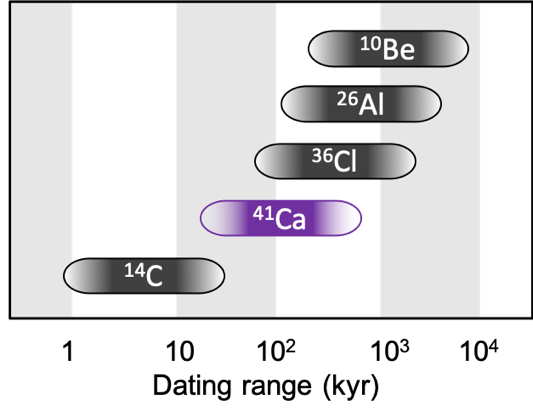
Fig 2. Dating Range of 41Ca.
Sample Size
The sample form required for Atom-Trap Trace Analysis (ATTA) is metallic calcium. A single measurement consumes approximately 0.1 g of metallic calcium. We have established methods for extracting metallic calcium from various environmental samples, including seawater, foraminifera, corals, rocks, bones, and loess. Table 1 lists the required sample sizes for several typical samples.
Table 1. Sample Size Requirements for Typical Samples.
| Sample | Typical sample size | |
|---|---|---|
| Hydrosphere | Seawater | 0.3 L |
| Foraminifera | 0.4 g | |
| Coral | 0.4 g | |
| Lithosphere | Granite | 20 g |
| Limestone | 0.3 g | |
| Loess | 3 g | |
| Biosphere | Bone (or fossil) | 0.3 g |
Application Examples
41Ca has important applications in fields such as Earth and Environmental Sciences. The following research can be conducted based on 41Ca: